


Blog
What to Look for When Buying a Used Car: A Practical UK Buyer’s Guide
A practical guide to help you make a confident and informed decision.

Buying a used car should not feel like a gamble.
There are thousands of good used vehicles on the road, and buying second-hand can often get you a better specification or a higher-quality car for the same budget. The important part is knowing how to separate a genuinely good vehicle from one that simply photographs well.
Some problems are obvious. Others only become noticeable once you start looking at the paperwork, checking the tyres or actually driving the car.
If you’re thinking about buying a used car, these are the things worth checking before you make a decision.
Start with the car’s history, not its appearance
It’s easy to get distracted by glossy paintwork and a freshly cleaned interior.
Before spending too much time deciding whether you like the car, establish whether its background makes sense.
Check the registration against the MOT history and look for anything unusual in the mileage progression. A vehicle history check can also help identify issues such as previous insurance write-offs, outstanding finance or other recorded problems.
What you’re really looking for is consistency.
If a car is advertised as having covered 48,000 miles but its previous records suggest something different, don’t ignore it.
The same applies to servicing. A car doesn’t necessarily need a book full of stamps from a main dealer, but there should be reasonable evidence that someone has been looking after it.
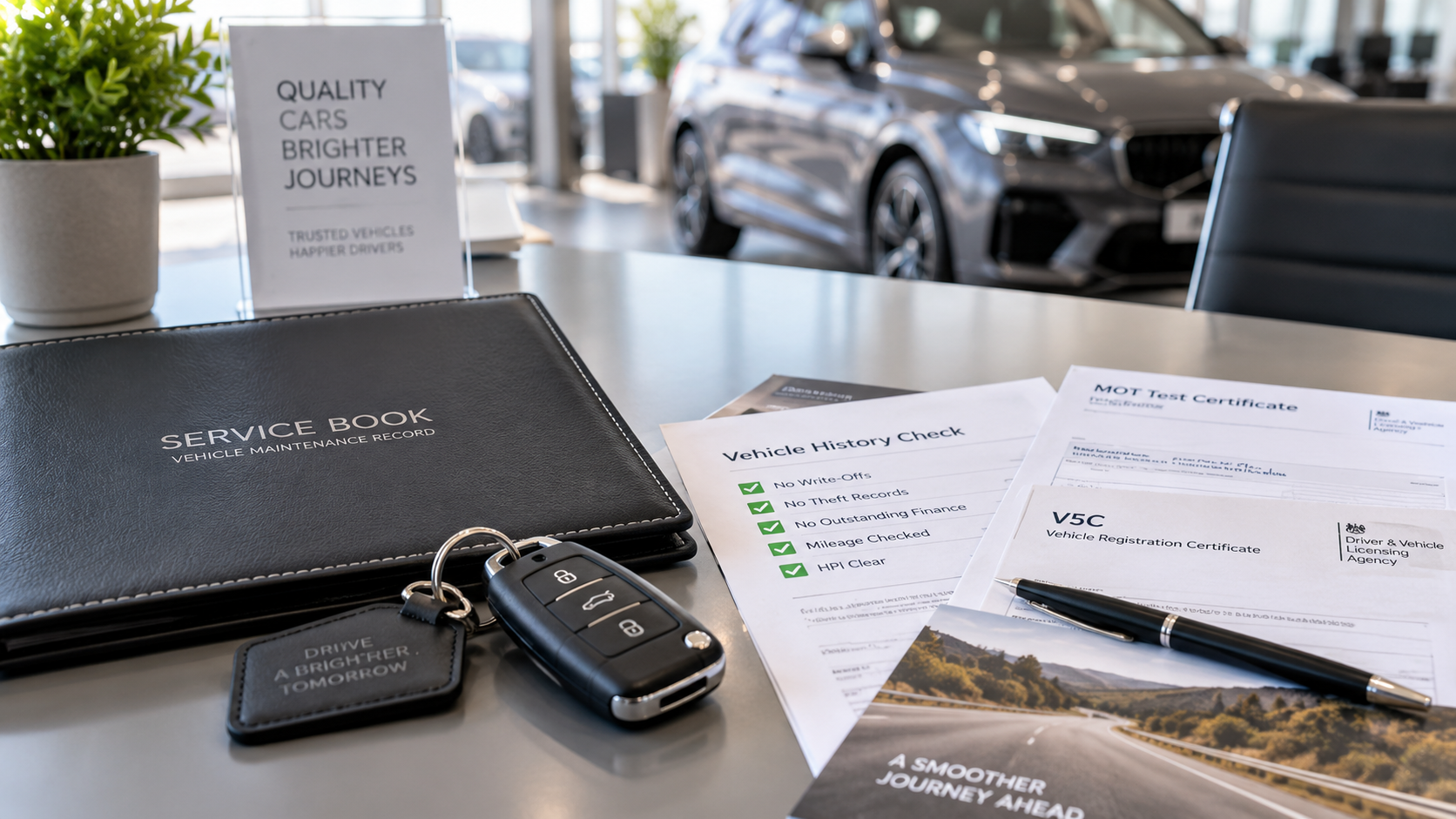
A quick paperwork checklist
Before buying, make sure you can verify the basic details.
- V5C registration document
- Current mileage
- MOT history
- Number of keys
- Service history or maintenance invoices
- Any important repair or maintenance receipts
- Vehicle identification number (VIN)
If something important is missing, ask why.
Missing paperwork doesn’t automatically mean there’s something wrong with the car, but it should affect how confidently you assess it.
Look at the car in daylight
If possible, inspect a used car during the day rather than under artificial showroom lighting or late in the evening.
Walk around it slowly. You’re looking for differences rather than perfection.
Slight stone chips and small scratches are completely normal on a used vehicle. What deserves closer attention is mismatched paint, unusual panel gaps, overspray around seals or a panel that reflects light differently from the rest of the body.
Those things can indicate previous body repairs. That isn’t automatically bad either. Plenty of properly repaired cars are perfectly good vehicles. You simply want to know what you’re buying.
Pay particular attention to:
- Doors and panels
- Do they line up properly and open cleanly?
- Paintwork
- Does one panel look newer or slightly different in colour?
- Windscreen
- Check for chips or cracks, particularly in the driver’s field of vision.
- Lights
- Look for condensation, cracks or damaged lenses.
- Underneath the vehicle
- Obvious fluid leaks or significant corrosion deserve further investigation.
Tyres tell you more than you might think
Don’t just check whether the tyres look new. Look at how they have worn.
A tyre wearing heavily on one edge may point to tracking, suspension or alignment issues. If all four tyres are close to the legal limit, factor replacement into your budget.
You should also look at what tyres have actually been fitted.
Four decent matching tyres suggest a different level of maintenance than four completely different budget tyres fitted at different times.
What to check:
| Check | What you’re looking for |
|---|---|
| Tread | Adequate tread across the tyre |
| Wear pattern | Even wear across the width |
| Sidewall | No cuts, bulges or cracking |
| Matching tyres | Ideally sensible matching pairs or sets |
| Spare / repair kit | Present and usable where applicable |
The interior should match the mileage
An odometer gives you a number. The interior gives you context.
A car with 30,000 miles should generally not have a completely worn steering wheel, badly collapsed driver’s seat and polished-smooth pedals.
Likewise, a well-kept 90,000-mile vehicle can sometimes feel much fresher than a neglected lower-mileage example.
Look at the areas the driver touches most:
- Steering wheel
- Gear selector
- Pedals
- Driver’s seat bolster
- Window switches
- Indicator stalks
Then test everything.
Air conditioning, electric windows, infotainment, central locking, parking sensors, cameras, heated seats and electrically adjustable mirrors can all become expensive annoyances if you discover faults after buying the car.
Don’t skip the cold start
This is one of the simplest checks and one of the most useful.
If possible, see the vehicle before the engine has been warmed up. Start it and listen.
You don’t need mechanical expertise to notice when something sounds wrong.
A healthy engine should usually settle into a reasonably smooth idle fairly quickly. Warning lights should illuminate as part of the ignition check and then disappear once the engine is running, apart from those that are supposed to remain active.
Listen for anything obviously unusual: loud knocking, persistent rattling, rough idle or excessive smoke deserve further investigation.
Don’t let a seller explain away an obvious problem without understanding what it actually is.
Then drive it properly
A five-minute loop around a car park tells you very little.
If possible, drive the car in conditions similar to how you’ll actually use it.
For a family SUV, that may mean some town driving and a faster road. For a small hatchback, pay attention to visibility, clutch control and how easy it is to manoeuvre.
During the test drive, think about more than whether you simply “like” the car.
Ask yourself:
- Does it drive straight without constant steering correction?
- Do the brakes feel smooth?
- Does the clutch engage cleanly?
- Does the gearbox shift properly?
- Are there knocks from the suspension?
- Is there vibration at speed?
- Does the engine pull consistently?
- Does the temperature remain stable?
And perhaps most importantly: does the car actually suit you?
A technically good vehicle can still be the wrong purchase if the driving position is uncomfortable, the boot isn’t large enough or rear visibility bothers you.
Used-car checks at a glance
If you’re viewing several vehicles, it can be useful to keep the basics simple.
| Area | Check before buying |
|---|---|
| History | MOT, mileage and vehicle history |
| Maintenance | Service records and receipts |
| Exterior | Paint, panels, lights and glass |
| Tyres | Tread, wear and condition |
| Interior | Wear, electronics and controls |
| Engine | Cold start, noise, leaks and warning lights |
| Test drive | Steering, brakes, gearbox and suspension |
| Documents | V5C, VIN, keys and records |
| Costs | Insurance, tax, tyres and upcoming servicing |
Don’t choose purely on mileage
Mileage matters, but it shouldn’t become the only number you look at.
A 40,000-mile vehicle that has spent years making very short journeys and receiving minimal maintenance isn’t automatically better than a well-serviced 70,000-mile motorway car.
Condition, history, ownership and maintenance all matter.
This is also why two apparently identical used cars can deserve very different prices.
Think about what happens after you buy it
Before agreeing to a car, look beyond today’s purchase price.
Suppose you’re comparing these two vehicles:
Car A £10,500
Needs four tyres soon, service due, brakes approaching replacement.
Car B £11,250
Recently serviced, good tyres, brakes replaced.
The cheaper vehicle isn’t necessarily the cheaper one.
That difference becomes even more important with premium cars, larger SUVs and performance models where routine maintenance can cost considerably more.
Don’t use your entire budget to buy the car. Leave some room for insurance, servicing and unexpected maintenance, particularly when buying an older vehicle.
Questions worth asking the seller
There is nothing wrong with asking direct questions.
A straightforward seller should be comfortable discussing the vehicle. Try asking:
- How long have you had the car?
- Why is it being sold?
- When was it last serviced?
- Is there anything currently wrong with it?
- Has it had any significant bodywork?
- When were the tyres last replaced?
- Are both keys available?
- Is there anything I would need to spend money on soon?
The answer itself matters, but so does how comfortably and consistently the seller answers.
What if you don’t know much about cars?
You don’t need to become a mechanic before buying one.
The important thing is knowing when something is outside your confidence level.
If you’re unsure about the mechanical condition of a vehicle, arranging an independent inspection can be worthwhile, particularly when buying an expensive, unusual or older car.
Paying for professional advice before buying is usually much cheaper than discovering a major problem afterwards.
Buying privately vs buying from a dealer
Neither route automatically guarantees a good or bad vehicle, but the experience is different.
| Private seller | Motor dealer |
|---|---|
| May offer a lower asking price | Often easier to compare several vehicles |
| You deal directly with the owner | Business purchase process |
| More responsibility falls on the buyer | Stronger consumer protections generally apply |
| Vehicle may still be in daily use | Cars are presented specifically for sale |
What matters is understanding who you are buying from and what protections apply to the transaction.
The best used car isn’t always the newest one
People often start their search with an age, mileage and budget in mind. That’s sensible.
But once you actually start comparing vehicles, condition usually becomes much more important.
A carefully maintained five-year-old car can be a considerably better buy than a neglected three-year-old example.
So don’t buy a specification sheet. Buy the actual car in front of you.
Final thoughts
A good used-car purchase usually comes down to patience.
Check the history. Look around the vehicle properly. Drive it. Ask questions. And don’t be afraid to walk away if something doesn’t add up.
There will always be another car.
If you’re looking for a particular make, model or body type around Wellingborough or Northamptonshire, Adams Motors can also help you discuss what type of vehicle you’re looking for and what may currently be available.

Ready When You Are
Looking for your next car?
Tell Adams Motors the type of vehicle you're interested in and send your requirements directly through WhatsApp.